
Yayoi Kusama was one of the most recognizable names in modern contemporary art. Known around the world for her colorful polka dots, mirrored installations, pumpkins and endless visual patterns, the Japanese artist built a career that lasted for decades. Her work became a global cultural phenomenon, appearing in major museums and attracting millions of visitors.
But Kusama’s legacy has also faced serious criticism. In 2023, passages from her earlier writings came under renewed scrutiny because of descriptions of Black people that critics characterized as racist and demeaning. The controversy raised an uncomfortable question for the art world: Can audiences celebrate an artist’s extraordinary work while also honestly confronting harmful things that artist said or wrote?
The answer is not necessarily simple.
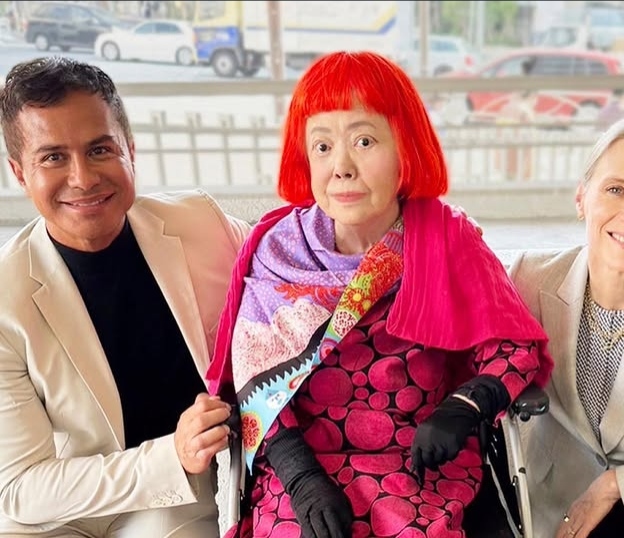
Why Was Yayoi Kusama Accused of Racism?
Yayoi Kusama The controversy centered largely on material in Kusama’s autobiography, Infinity Net, originally published in Japanese and later translated. Critics highlighted passages containing negative stereotypes about Black people, including descriptions that portrayed them through racialized and sexualized imagery. The discussion became particularly prominent in 2023, when the material was brought back into public attention around Kusama’s exhibition at the San Francisco Museum of Modern Art.
The criticism was not simply about an artist using provocative language. Critics argued that the descriptions reduced Black people to stereotypes and treated race in a way that was deeply offensive.
Some of the passages also discussed New York neighborhoods and associated Black residents with crime and declining property values. According to reporting at the time, some of those sentences appeared in the original Japanese edition but were removed from a later English translation.
That difference between editions became another part of the discussion because it raised questions about how Kusama’s writing had been presented to international audiences.
Kusama Apologized
Yayoi Kusama did not simply ignore the controversy.
In October 2023, shortly before her San Francisco exhibition opened, she expressed regret over the language in her book. In a statement published by the San Francisco Chronicle, she said she deeply regretted using hurtful and offensive language and apologized for the pain it caused. She also emphasized that her broader message was intended to be about love, hope, compassion and respect for people.
Her apology became an important part of the public conversation.
An apology does not automatically erase the harm caused by offensive words. At the same time, an artist’s response matters when assessing how society should understand controversial parts of a long career.
This is why describing the situation simply as “Yayoi Kusama is racist” can leave out important context. There is documented evidence of offensive and racist language in her earlier writing, and she later apologized for it. Whether someone considers that evidence enough to describe Kusama personally as a racist is ultimately a judgment, but the writings themselves deserve serious examination.
A Complicated Artistic Legacy
Yayoi Kusama’s career cannot be reduced to the controversy.
Born in Matsumoto, Japan, in 1929, she developed an artistic language built around repetition, infinity and self-obliteration. She moved to New York in the late 1950s and became involved in the city’s experimental art scene.
Her career was not always easy. She experienced sexism, cultural barriers and racism herself as a Japanese woman working in the American art world. Her work was also sometimes overshadowed by better-known male artists.
Over time, however, Kusama became internationally famous. Her Infinity Mirror Rooms transformed her work into an immersive experience rather than something audiences simply viewed from a distance. Her pumpkins, dots and mirrored environments became instantly recognizable.
By the later part of her career, she was celebrated as a pioneering figure in contemporary art. Major museums around the world exhibited her work, and her influence reached far beyond traditional galleries.
That makes the racism controversy more complicated, not less.
Can Great Art Come From a Flawed Person?
This is probably the biggest question raised by the Yayoi Kusama controversy.
Artists are human beings, and human beings can hold contradictory ideas. Someone can create work about universal love while also having written offensive things. Someone can challenge discrimination in one part of their life while repeating harmful stereotypes somewhere else.
That contradiction can be uncomfortable.
Some people believe an artist’s personal beliefs should fundamentally change how we view their work. Others believe the artwork should be judged independently from the artist.
There is also a middle position: appreciate the art while refusing to ignore the artist’s harmful statements.
That approach may be the most useful when discussing Kusama.
It is possible to admire the creativity behind an Infinity Mirror Room and still acknowledge that her earlier descriptions of Black people were offensive. These two facts do not cancel each other out.
The Role of Museums
Yayoi Kusama The controversy also placed museums under pressure.
When museums present famous artists, they are not simply displaying objects. They are helping shape the public understanding of that artist’s legacy.
Critics questioned whether Kusama’s San Francisco exhibition should have addressed the controversial writings more openly. The debate became particularly important because the exhibition was marketed around themes associated with love and inclusivity.
Museums therefore face a difficult responsibility. They do not necessarily have to remove controversial artists from exhibitions, but they can provide context.
Showing an artist’s achievements alongside difficult parts of their history can make exhibitions more educational and honest.
Why Context Matters
It is also important to understand the historical background without using it as an excuse.
Yayoi Kusama grew up in Japan in the 1930s and later entered the American art scene during a period of major social and political change. Racial stereotypes existed in popular culture in both Japan and the United States, and Kusama encountered many different cultures after moving to New York.
Historical context can help explain where prejudiced ideas came from.
But context is not the same as justification.
People can understand why a particular belief existed while still recognizing that the belief was harmful. That distinction is important when discussing historical figures.
Kusama’s Apology and What Comes Next
Yayoi Kusama apology did not end the debate, and perhaps it was never realistic to expect it to.
For some people, an apology represents accountability and an opportunity for reflection. For others, the damage caused by racist language cannot be resolved simply by saying sorry.
Both reactions are understandable.
What matters is that the controversy is not hidden.
Kusama’s legacy can be discussed honestly: she was an enormously influential artist who broke boundaries, faced discrimination herself, created groundbreaking work and became an international icon. She also produced writings containing language that caused real offense and attracted legitimate criticism.
Those realities can exist together.
Final Thoughts
The question “Was Yayoi Kusama racist?” does not have to be answered with a simple yes or no.
There is strong documentation that Kusama’s earlier writings contained anti-Black stereotypes and language that critics reasonably described as racist. She later publicly expressed regret and apologized for the offensive language.
At the same time, her entire life and career cannot be summarized by those passages.
Kusama’s story is ultimately a reminder that famous people, including celebrated artists, can have complicated and contradictory legacies. Admiring someone’s creativity does not require ignoring their mistakes. Likewise, criticizing harmful behavior does not require pretending that a person’s artistic achievements never existed.
The most honest way to remember Yayoi Kusama is therefore to look at the complete picture — the groundbreaking art, the difficult personal history, the barriers she faced, the enormous influence she achieved, and the troubling words that became part of her legacy.
A mature discussion of art should have room for all of those truths at once.
Japanese artist Yayoi Kusama, who filled the world with polka dots, dead at 97