
If you are searching “what time is the lunar eclipse tonight?”, there is an important detail to know: the August 2026 lunar eclipse occurs across August 27–28, depending on your location and time zone. Because such a large portion of the Moon enters the umbra, the event can look remarkably similar to a total lunar eclipse, with the shadowed portion potentially taking on a reddish or coppery color.
For people in India, however, there is a major catch: the August 28, 2026 lunar eclipse is not visible from India. The eclipse occurs while the Moon is below the horizon for Indian observers. So although the astronomical event is taking place, skywatchers in India will not be able to watch the eclipse directly from their locations.
What Time Is the Lunar Eclipse Tonight?
The exact timing depends on where you are in the world.
The partial lunar eclipse reaches its maximum at approximately 12:12 a.m. EDT on August 28, which corresponds to 04:12 UTC. At this point, approximately 96.2% of the Moon’s disk is inside Earth’s darkest shadow.
In the United Kingdom, the important stages occur during the early morning of August 28. The penumbral phase begins around 2:23 a.m. BST, the partial eclipse begins at about 3:33 a.m., and maximum eclipse occurs around 5:12 a.m. BST. The partial phase ends at approximately 6:51 a.m., although the Moon sets before the eclipse has completely finished in many locations.
For Indian viewers, the astronomical timing falls during the daytime. Reports place the eclipse from approximately 8:04 a.m. to 11:21 a.m. IST, with the maximum occurring around 9:44 a.m. IST. Since the Moon is below the horizon from India during the event, the eclipse cannot be seen directly from the country.
Is Tonight’s Eclipse a Total Lunar Eclipse?
No. The August 28 event is officially a partial lunar eclipse, not a total lunar eclipse.
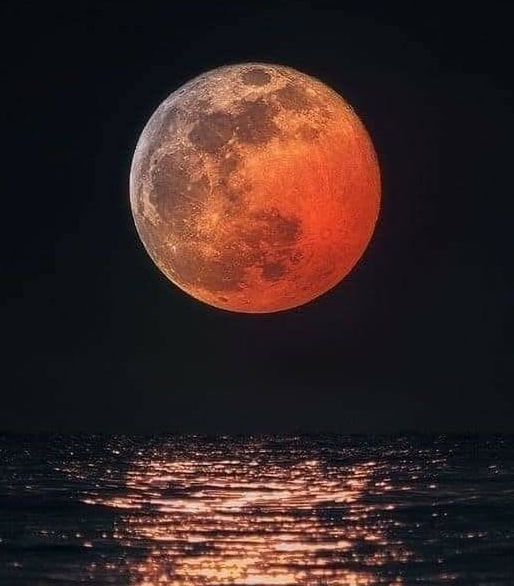
But this is not an ordinary partial eclipse. Around 96% of the Moon will enter Earth’s darkest shadow, leaving only a small bright portion outside the umbra. That is why the eclipse has been described as an “almost blood moon” event.
A total lunar eclipse happens when the entire lunar disk moves into Earth’s umbra. During this event, a small section of the Moon remains outside the darkest shadow, preventing it from becoming a true total lunar eclipse.
Still, for viewers in the right parts of the world, the sight should be spectacular.
Why Does the Moon Turn Red During a Lunar Eclipse?
One of the most fascinating parts of a lunar eclipse is the Moon’s changing color.
When Earth moves between the Sun and Moon, our planet blocks direct sunlight from reaching the lunar surface. However, Earth’s atmosphere still allows some sunlight to reach the Moon. The atmosphere scatters shorter blue wavelengths of light more strongly while allowing more red and orange light to pass through and bend toward the lunar surface.
That reddish light can illuminate the Moon during the deepest part of an eclipse.
This is why people often call a lunar eclipse a “Blood Moon.” The term is popular rather than a formal scientific classification. During the August 2026 eclipse, the Moon may develop a noticeable reddish, orange or copper-like appearance in areas where the eclipse is visible.
Where Can You See the August 2026 Lunar Eclipse?
The best viewing opportunities are in North America and South America, where observers can experience much more of the eclipse.
Parts of Europe and Africa can also see the event, although the timing means the Moon will be relatively low in the sky in some locations. Observers in the United Kingdom and Ireland, for example, will see the eclipse during the early morning hours, with the Moon getting closer to the horizon as the event progresses.
Parts of western Asia have limited visibility, while much of eastern Asia will have little or no opportunity to see the eclipse directly.
India falls into the latter category for this particular event. The eclipse itself is real and occurs at the calculated astronomical time, but the Moon is below India’s horizon when the relevant phases take place.
Can You Watch the Lunar Eclipse Without Special Equipment?
Absolutely.
Unlike a solar eclipse, a lunar eclipse is safe to view with the naked eye. You do not need special eclipse glasses or protective filters to watch the Moon.
If you are located somewhere with good visibility, simply find a place with an unobstructed view of the sky. A dark location away from bright city lights can make the experience even better.
Binoculars or a small telescope can provide a closer look at the changing shadow across the lunar surface, but they are not necessary.
For photographers, a tripod and a camera capable of manual exposure settings can help capture the reddish Moon and the progression of Earth’s shadow.
What If You Cannot See the Eclipse From Your Location?
Don’t worry if the Moon is below your horizon or clouds prevent you from seeing it.
Astronomy organizations and space websites are providing online coverage and livestreams for the August 27–28 lunar eclipse. Some livestreams begin before the main event and include commentary explaining what is happening as Earth’s shadow moves across the Moon.
This is particularly useful for viewers in India and other parts of Asia where the eclipse cannot be observed directly.
Is There Anything Special About This Eclipse?
Yes. The August 2026 eclipse is notable because it is an exceptionally deep partial eclipse. With approximately 96% of the lunar surface entering Earth’s umbra, only a narrow portion remains outside the darkest shadow at maximum.
The event also comes shortly after the August 12, 2026 solar eclipse, making August an especially interesting month for skywatchers. Eclipses often occur in pairs or groups because of the geometry of the Sun, Earth and Moon during eclipse seasons.
Although it is not technically a total lunar eclipse, its appearance could be dramatic enough to resemble one at first glance.
Final Answer: What Time Is the Lunar Eclipse Tonight?
If you’re in India, the August 28, 2026 lunar eclipse occurs approximately from 8:04 a.m. to 11:21 a.m. IST, with maximum eclipse around 9:44 a.m. IST. However, it is not visible from India because the Moon is below the horizon during the event.
For viewers in the Americas, Europe and Africa, the eclipse occurs during local nighttime or early morning hours, depending on the location. The maximum occurs at about 04:12 UTC on August 28, when approximately 96% of the Moon will be inside Earth’s darkest shadow.
So, if you’re wondering whether you should step outside tonight to see the lunar eclipse, the answer depends entirely on where you live. Check your local eclipse timing and Moon position before heading out.
And if you’re in India, you haven’t missed the event because of bad weather—the Moon simply won’t be above the horizon when the eclipse happens. An online livestream is your best option for watching this remarkable celestial event.